


Being cultured signifies richness. It is something built upon the cooperation of all humanity, and it guides the development of the mind, which is the invisible infrastructure of a civilized society. We have discussed cultural education in Montessori education from a scientific perspective.
We’d love to hear your thoughts. Feel free to share your comments!
Profile
Yati Obara
Editor-in-Chief, Scientific Montessori
Based in Japan, born in 1989. CEO of Motherhand and Co-Director of the nonprofit think tank Polymath Research. Holds an M.Eng. and is an AMI-certified teacher. Focused on Montessori developmental theory and AI. Mother of two.
Hiro Obara
Publisher, Scientific Montessori
Based in Japan, born in 1990. CEO of StudyX and Co-Director of the nonprofit think tank Polymath Research. Works as a software developer and game designer. Father of two.
Liberal arts for children from birth.
Yati
Today’s topic is “cultural education.” Your first question might be, “What is cultural education?” Just as schools have subjects like language arts, math, and science, Montessori education has areas such as “language” and “mathematics.” One of those areas used to be called “cultural education.” It covers content like geography, history, biology, and physics, topics that children can start learning as early as 3 to 6 years old. I said “used to be called” because the term “culture” was considered too broad and has been reconsidered. In the international training course I took, it was renamed “language extensions” or folded into the “sensorial” area.
Hiro
I didn’t know that.
Yati
“Cultural education” probably isn’t Maria Montessori’s own term. It seems to have been coined later. Here’s what Montessori herself said: “We discovered that education is not something the teacher gives, but a natural process that develops spontaneously in the human being. It is not acquired by listening to words, but through experiences the child has in acting on the environment. The teacher’s task is not to talk, but to prepare and arrange a series of motives for cultural activity in a special environment made for the child.” I think she saw everything as culture.
Hiro
So there’s nothing that can’t be called culture?
Yati
Exactly. Maria Montessori observed children around the world and discovered that “humans possess the ‘absorbent mind’ only during the years 0 to 6.” The absorbent mind is like a sponge that takes in everything, language, food, clothing, people’s attitudes and behaviors, and uses it all to build the self, becoming a unique individual. Everything absorbed by the absorbent mind could be called culture.
Hiro
Changing the subject a bit: I believe that to discuss Montessori education scientifically, we need to translate Montessori-specific terms into language shared by other academic fields. Take the word “absorb” in “absorbent mind.” Isn’t it an unsuitable metaphor? In both neuroscience and engineering, “learn” would be more accurate.
Yati
I never thought of it that way. Having once immersed myself in Montessori education, I feel a certain resistance to that idea. But when I recall first learning about Montessori, I did feel a lot of confusion. I kept asking, “What does ‘didactic material’ mean?”
Hiro
To me, “didactic material” sounds like “brain-training equipment.”
Yati
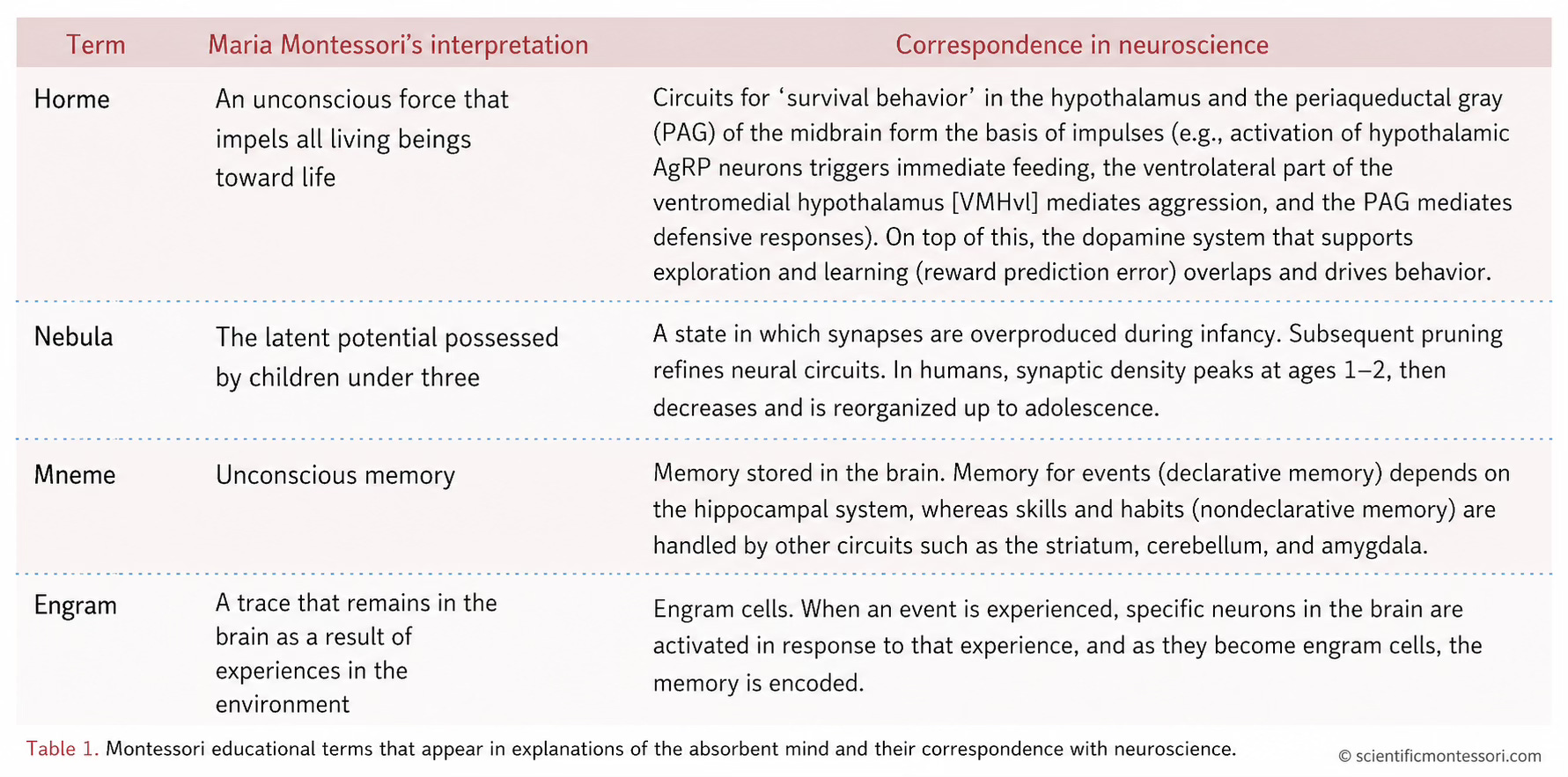
That makes sense. It’s consistent with our pilot issue, “Raising Children Is Growing Brains.” The discussion of the absorbent mind is really about brain science, but since neuroscience wasn’t well developed in Maria Montessori’s time, she borrowed terms from biology, psychology, and philosophy, and used metaphors, to explain her ideas. Terms like “horme,” “mneme,” “nebulae,” and “engram” unnecessarily raise the barrier to learning Montessori education. This seems like a good opportunity to create a table mapping those terms to neuroscience.
Hiro
That makes it much clearer. Getting back to “cultural education,” I personally think these areas can also be organized in terms of brain science.
Yati
What do you mean?
Hiro
List the Montessori areas for me.
Yati
“Language,” “mathematics,” “sensorial,” “practical life,” and “cultural education.”
Hiro
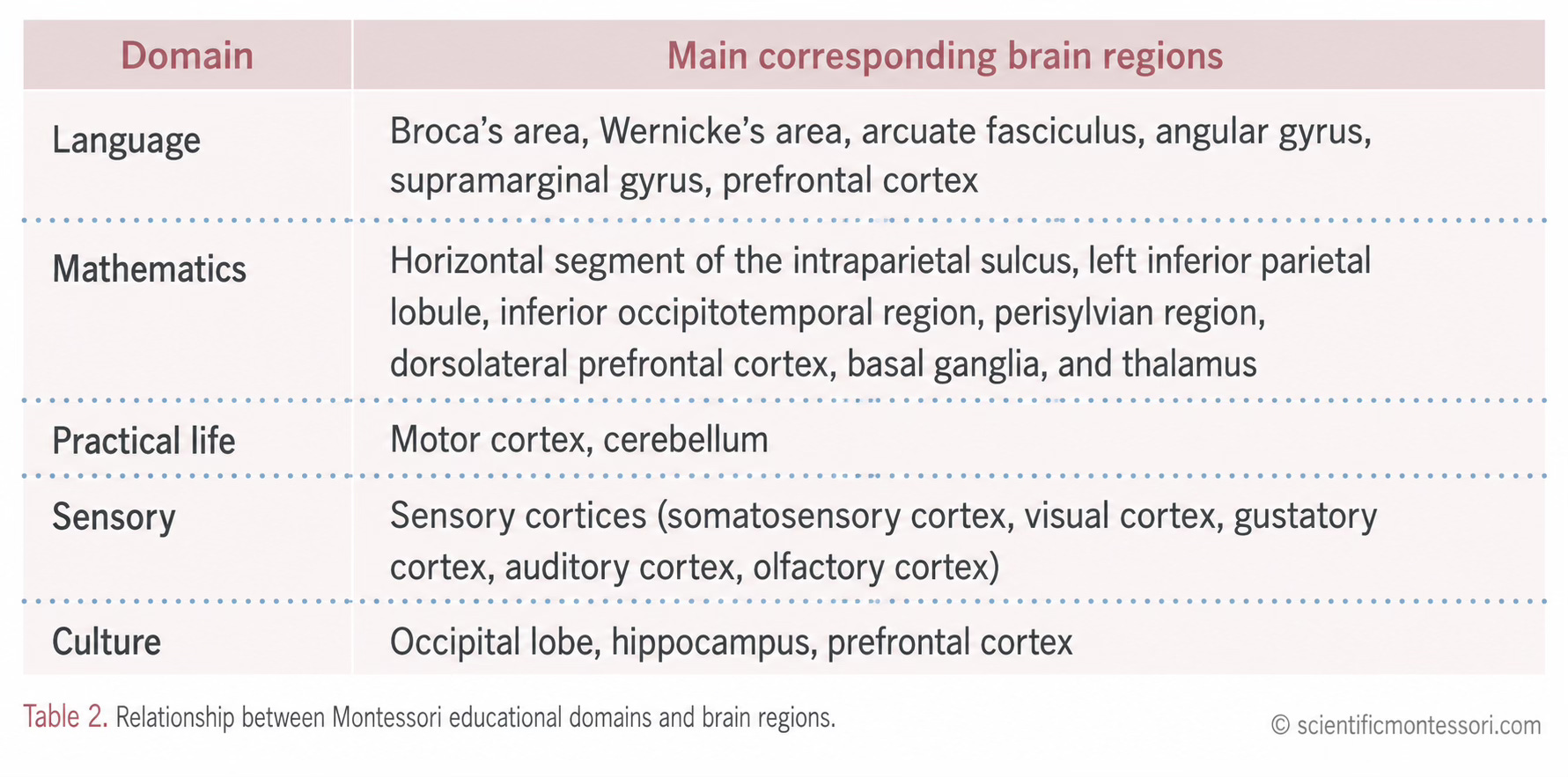
These areas roughly correspond to regions of the brain. “Language” corresponds to the language areas in the brain. “Mathematics,” as we covered in an earlier issue, also has corresponding brain regions. “Sensorial” corresponds to the sensory cortex. “Practical life” involves movement, so it corresponds to the motor cortex.
Yati
You’re right. This is groundbreaking. I’d wondered whether the way Montessori divides these areas was a bit odd, but it turns out they’re designed to develop the whole brain in a balanced way.
Hiro
Exactly. As for “cultural education,” I think it corresponds to the occipital lobe.
Yati
Tell me more.
Hiro
I’ve been studying neuroscience lately, so I know a bit about the brain. The occipital lobe, at the back of the brain, handles vision, processing images, perceiving your position in space, and so on.
Yati
I looked it up, and it recognizes the shape, color, and speed of movement of things you see. It also recreates what you’ve seen. It works with the hippocampus for memory and the prefrontal cortex for judgment, so you can decide, “The light is red, so I shouldn’t cross.”
Hiro
It’s also the area involved in viewing things and enjoying visual experiences. That’s what “cultural education” corresponds to. Or maybe we should call it “knowledge education.”
Yati
Right.
Hiro
Isn’t “cultural education” really training to expand knowledge? It doesn’t matter whether the knowledge is about another culture or your own; it’s simply about gaining knowledge and becoming more cultured, developing general education. Like a culture course.
Yati
A “culture center”!
Hiro
The English word “culture” is broad, but personally, I feel what we’re really pointing at here is “liberal education,” or cultivation.
Yati
So it was “liberal-arts education” all along.
Hiro
Exactly. Liberal arts.
Yati
So, what should we do to cultivate liberal arts starting from ages 0 to 3?
Hiro
Liberal arts from ages 0 to 3, huh? Anything works, really, but the biggest bottleneck isn’t the environment. It’s the parents and other adults.
Yati
Mm-hmm.
Hiro
For example, families that visit art museums are different from those that don’t. Their motivation toward art is different.
Yati
True. The same goes for science museums. Did you go to art museums as a child?
Hiro
Actually, I grew up in Iwate Prefecture, in northern Japan, where artwork was displayed all around town, so I didn’t need to go to a museum. [laughs]
Yati
That’s not fair!
Hiro
I got to see works by Shigeo Fukuda, a world-renowned Japanese graphic designer, for free.
Yati
Learning from world-class art. Oh, if I say “absorbing,” you’ll scold me again. Learning from world-class art.
Hiro
Learning. And it’s not just art. Culturally rich towns let you feel “culture” in general. Literature, too.
Yati
Iwate is brimming with traces of Kenji Miyazawa, the beloved Japanese poet and children’s author from that region.
Hiro
If you grow up in a place without a local poet or author, you won’t feel close to literature, unless your parents engage with it themselves.
Yati
In the end, for liberal arts from 0 to 3, “Move to a culturally rich city” is a sad conclusion, but Morioka really is a cultural place. In my Montessori international course, a trainer from abroad said, “Enjoy outdoor concerts in the plaza with your baby.” I thought, “That’s just overseas culture.” But when I came to Morioka, the capital of Iwate Prefecture, there’s a weekly evening street market called Yo-ichi with authentic string-instrument performances, and kids dancing along.
Hiro
Even the nearby Aeon mall had flute trios.
Yati
Exactly. At Yo-ichi, high-school calligraphy clubs do live performances writing giant pieces. Walking around, you see statues of Kenji Miyazawa. There’s Kōgensha, a shop featuring traditional folk crafts from all over Japan. There used to be Iwaizumi Junboku Kagu, a furniture shop whose motto was “Wood that has lived for three hundred years becomes furniture you can use for three hundred years,” though it’s closed now. And adults are having a blast with sea urchin, oysters, local craft beer, and wine.
Hiro
This is turning into a Morioka advertisement.
Yati
But even in Fukuoka, in southern Japan, the Kyushu Symphony Orchestra held concerts that babies could attend. If you look, you can find things like that.
Hiro
True. There’s usually something. Even if you don’t search, you might try attending something you normally ignore, like sumo wrestling or rakugo, the Japanese art of comic storytelling, whatever.
Yati
Right. Culture isn’t just about enjoying it. There’s also the side of creating it.
Hiro
Culture is an accumulation of comprehensive arts. You could call it humanity’s collective memory. Every region has its own culture, an aggregate of the activities of the people who’ve lived there. In simple terms: what have people done? That’s shaped by script, language, customs, climate, and environment. When we say “cultural education,” it encompasses tremendous diversity.
Yati
For example?
Hiro
Take writing systems. Not everyone uses the same script. Chinese people use Chinese characters, English speakers use the Roman alphabet, Japanese people use Japanese script, and each system developed differently. Ideographic scripts express meaning; phonetic scripts express sound. These differences give rise to people who prefer manga and anime, or people who prefer music and podcasts. It’s less about preference and more about aptitude.
Yati
Interesting.
Hiro
Ultimately, human art may be an extension of language. Trace it back far enough and you reach the cave paintings at Lascaux or Altamira. At its core, culture begins with “expressing what you want to express.” Art came first, then art developed, and writing and numbers emerged. Those developed further into scholarship and technology.
Yati
What about religion?
Hiro
Religion? That came even before writing and numbers. Art developed and gave rise to religion. Idol worship: shaping gods into figures, venerating them, feeling gratitude. Everything starts with art. Work, too, began there.
Yati
To apply this to children’s education, should we trace that history?
Hiro
“Cultural education” sounds vague, but essentially, you should have something you want to express and develop the habit of expressing it. First, it’s important to have something you want to express. Second, you need the freedom to express it however you like. Freedom of expression. Freedom of speech and expression really matter for a culturally rich life.
Yati
When 1- to 2-year-olds paint with paints, the pictures are unique, and the moment they’re painting looks like pure joy. The act of painting and expressing is more important than the finished piece. In my Montessori international course, we were explicitly taught, “Art activities exist solely for children’s self-expression.” That’s how much care is needed, adults must refrain from evaluating, to achieve true free expression. Let me close with a quote from Maria Montessori: “If we wish to give the child the joy of drawing, we must create in him an eye that sees, a hand that obeys, and a soul that feels.”
Hiro
In other words: “Children seek not evaluation, but the opportunity for self-expression.”


